Thursday, October 30, 2008

Monday, October 27, 2008
A Word A Day
Do you know this website? It's often too obscure to be good for SAT skills, but why learn useful vocabulary when you can learn awesome vocabulary? This week's theme covers my all time favorite vocabulary topic: words that mean one thing ... and its opposite.
When you sanction a project, do you approve of it or disapprove? Should one be commended for oversight (watchful care) or reprimanded for oversight (error or omission)? When you resign from a job, do you leave it or re-join (re-sign) it?This week's first word is cleave. Check out Anu Garg's site here.
When a proposal gets tabled, is it being brought forward for discussion or being laid aside? Depends on which side of the pond you're at. If the former, you're in the UK; if the latter, you're in the US.
I call them fence-sitters. They sit on fences, ready to say one thing or its opposite depending on which side they appear at. I'm not talking about politicians. These are words, known by many names: autoantonym, contranym, self-antonym, enantiodromic, amphibolous, janus word, and so on.
Sometimes it's a result of two distinct words evolving into the same form (cleave from Old English cleofian and cleofan) but often a single word develops a split personality and takes on two contradictory senses. All of us have a bit of yin and yang and these words are no exception.
Sunday, October 26, 2008
Enrichment Reading: The Turing Test
There is way, way more cool stuff to read about the Turing Test than we'll have time for. I'll include a few here, and feel free to "comment" on more!
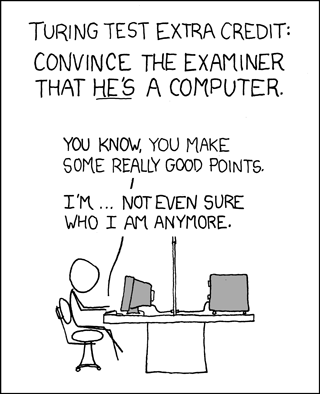
It's amazing that xkcd.com is such an entertaining web comic, given the quality of the artwork.
- Wired magazine has an article written by someone who participated in the Turing Test ... as one of the control "humans."
- The Stanford Encyclopedia of Philosophy has a very complete, fairly technical entry on the Turing test, its history, limitations, alternatives, etc, etc, etc.
- Read the New York Times on CAPTCHA and other forms of "reverse" Turing test ... a surprisingly practical problem.
- The Simon Laven page is just one of many with links to chatterbots you can talk to on your very own.
It's amazing that xkcd.com is such an entertaining web comic, given the quality of the artwork.
Class Calendar: October 27th to November 3rd
Monday, October 27th (T)
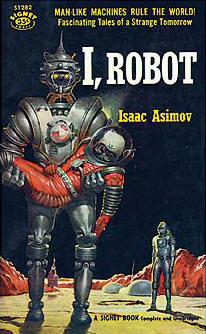
• Due: Read “Runaround” in I, Robot. Take some notes.
• Class: Discussion of the story; continuing our study of satire with “Fear of a Bot Planet.”
Tuesday, October 28th (W)
• Class does not meet today.
Wednesday, October 29th (H)
• Due: Read “Reason” and “Catch that Rabbit” in I, Robot. Take some notes.
• Class: Discussion of the story; the Turing test.
Thursday, October 30th (F)
• Due: Read “Liar” in I, Robot. Take some notes.
• Class: Lesson: “Meditations on First Philosophy” by Adam. Discussion.
Friday, October 31st (S)
• Due: Read “Lost Little Robot” in I, Robot. Take some notes.
• Class: Discussion of the story; social critic Chuck Klosterman on the likelihood of hostile takeover by robot armies.
“Q: How would your views about war, politics, and the role of the military change if all future conflicts were fought by armies of robots (that is to say, if all nations agreed to conduct wars exclusively with machines so that human casualties would be virtually nonexistent)?”
— Chuck Klosterman, Chuck Klosterman IV
Monday, November 3rd (U)
• Due: Read “Escape” in I, Robot. Take some notes.
• Class: Discussion of the story and other fun to be announced.
Note: Have a spooky (and safe!) Halloween. There are no classes on Tuesday, November 4th, so if you are for any reason absent on Monday, check the calendar on the blog so as not to fall behind.
 Number Five is ALIVE!
• Due: Read “Runaround” in I, Robot. Take some notes.
• Class: Discussion of the story; continuing our study of satire with “Fear of a Bot Planet.”
Tuesday, October 28th (W)
• Class does not meet today.
Wednesday, October 29th (H)
• Due: Read “Reason” and “Catch that Rabbit” in I, Robot. Take some notes.
• Class: Discussion of the story; the Turing test.
Thursday, October 30th (F)
• Due: Read “Liar” in I, Robot. Take some notes.
• Class: Lesson: “Meditations on First Philosophy” by Adam. Discussion.
Friday, October 31st (S)
• Due: Read “Lost Little Robot” in I, Robot. Take some notes.
• Class: Discussion of the story; social critic Chuck Klosterman on the likelihood of hostile takeover by robot armies.
“Q: How would your views about war, politics, and the role of the military change if all future conflicts were fought by armies of robots (that is to say, if all nations agreed to conduct wars exclusively with machines so that human casualties would be virtually nonexistent)?”
— Chuck Klosterman, Chuck Klosterman IV
Monday, November 3rd (U)
• Due: Read “Escape” in I, Robot. Take some notes.
• Class: Discussion of the story and other fun to be announced.
Note: Have a spooky (and safe!) Halloween. There are no classes on Tuesday, November 4th, so if you are for any reason absent on Monday, check the calendar on the blog so as not to fall behind.
Number Five is ALIVE!
Sunday, October 19, 2008
Class Calendar: October 20th to October 27th
Note: Deadlines have been revised to reflect the one day extension on the paper!
Monday, October 20th (H)
• Due: Rough draft of paper on The Martian Chronicles or The War of the Worlds.
• Class: Finish Futurama; lesson assignment update; peer review of papers with attention to textual support.
Tuesday, October 21st (F)
• Due: Work on revisions to papers.
• Class: College essays; Bradbury videos; mini-lesson on quotation integration.
Wednesday, October 22nd (S)
• Due: Send me an email excerpt of your paper that uses a quotation.
• Class: Workshop on quotation integration.
Thursday, October 23rd (U)
• Due: Final draft of papers (double spaced, MLA format, in hard copy when you come to class). Also, I’ll be collecting your books – so bring them.
• Class: “The Three Laws of Robotics.”
Friday, October 24th (M)
• Due: Read “Introduction” and “Robbie” (to p. 30). Take SOME notes. They need not be exhaustive, for this text, but identify some discussion points you want to make.
• Class: Share yesterday’s work; discuss “Robbie.”
Monday, October 27th (T)
• Due: Read “Runaround” (to p. 47). Take notes.
• Class: Discuss “Runaround”; a brief history of robots.
Tuesday, October 28th (W)
• Due: Read “Reason” (to p. 64). Take notes.
• Class: Discuss “Reason”; other exciting revelations to be announced.
Monday, October 20th (H)
• Due: Rough draft of paper on The Martian Chronicles or The War of the Worlds.
• Class: Finish Futurama; lesson assignment update; peer review of papers with attention to textual support.
Tuesday, October 21st (F)
• Due: Work on revisions to papers.
• Class: College essays; Bradbury videos; mini-lesson on quotation integration.
Wednesday, October 22nd (S)
• Due: Send me an email excerpt of your paper that uses a quotation.
• Class: Workshop on quotation integration.
Thursday, October 23rd (U)
• Due: Final draft of papers (double spaced, MLA format, in hard copy when you come to class). Also, I’ll be collecting your books – so bring them.
• Class: “The Three Laws of Robotics.”
Friday, October 24th (M)
• Due: Read “Introduction” and “Robbie” (to p. 30). Take SOME notes. They need not be exhaustive, for this text, but identify some discussion points you want to make.
• Class: Share yesterday’s work; discuss “Robbie.”
Monday, October 27th (T)
• Due: Read “Runaround” (to p. 47). Take notes.
• Class: Discuss “Runaround”; a brief history of robots.
Tuesday, October 28th (W)
• Due: Read “Reason” (to p. 64). Take notes.
• Class: Discuss “Reason”; other exciting revelations to be announced.
Thursday, October 16, 2008
Potential Paper Topics
I'm including the whole list of topics brainstormed by the class.
I would just offer the following advice as you choose: (1) choose a topic that you can ground in specific textual evidence and (2) remember that this is a relatively short paper and choose a topic that will give you a manageable focus ("scope").
The War of the Worlds Ideas
• Explore parallels to colonialism: how the Martian invasion of Earth compares to England’s colonization of India, Africa, etc. What commentary is Wells making?
• How realistic are people’s reactions in Wells’s story, given the context of the time period? How would it differ today?
• How does the author’s view of religion, morality, and human nature come to light in the way mankind is portrayed in the face of invasion?
• How does H.G. Wells create a sense of realism? What parts of the story contribute to the verisimilitude?
• How does the devastation in Cormac McCarthy’s The Road mirror Well’s alien invasion? How has the view of humanity and crisis changed over a century? How has it remained the same?
• Compare to modern day events and reactions.
• Compare to The Road and the flight of humanity.
• How did the role of the narrator forge the book into a believable source?
• How was the book an allegory for contemporary world events?
• How does Wells exploit the technology and descriptions to instill fear?
• Do the predictions from the book hold true for the current day?
• What role does religion play in the book and how does Wells’s own view of religion impact the book?
• Choose two interacting characters and explore how humanity is portrayed.
• What is the main element of fear The War of the Worlds’s apocalypse uses?
• Despite the caveats, do you think Welles anticipated the reactions? (I assume this refers to the radio version.)
• How is humanity different from the aliens and how are they the same? Consider a comparison of Martian’s treatment of human’s to human’s treatment of animals and Native Americans. Are the aliens are selfish for not considering humanity’s desires?
• Are the aliens really a more advanced species? They have better technology and more advanced brains, but perhaps they are lesser because they have no place for love or emotion.
• How does the nameless narrator, who appears slowly discovering the Martian’s invasion, affect the story? (Another angle could be to compare the book’s narrator to the heroes of the 1953 and/or 2005 film versions, which you would then want to watch in full.)
• How are Wells’s socialist views portrayed in the novel? Consider the equality of a post-apocalyptic world without social classes. Consider its popularity during the Cold War, a time of ant-socialist sentiment?
The Martian Chronicles Ideas
• Is Bradbury’s view of humanity fundamentally pessimistic or optimistic?
• Explore an ethical dilemma raised in one or more of the stories in Martian Chronicles.
• Explore the development of a theme in a selection of Martian Chronicles stories. Use one of the “big ideas” we’ve been exploring or come up with you own.
• Do a “rhetorical analysis” of The Martian Chronicles, examining how the distinctive characteristics of Bradbury’s style (e.g., figurative language, artificial dialogue, etc) lend themselves to his purpose. You might cover the novel as a whole or select a few stories to focus on.
• What doe Bradbury’s novel suggest about sanity and insanity? Is madness an objective condition or a societal construct? (Consider the Captain’s reaction to Spender as well as the reaction of the Martians in the second expedition.)
• Explore Bradbury’s portrayal of gender roles. Is The Martian Chronicles sexist? You might specifically look at “The Silent Towns” in particular, as well as the female aliens in the first and second expeditions.
• How does Bradbury use the invasion of Mars by the human race to express his position on colonialism and Manifest Destiny?
• Which, if any, of Bradbury’s predictions have (or are likely to) come true? What was he wrong about? NB: Just be sure you can ground your answer in a meaningful interpretation of the text.
• How have humans changed to colonize Mars in The Martian Chronicles?
• What is Bradbury’s message about human technology?
The Martian Chronicles & The War of the Worlds Combined Ideas
• Take and answer any of the more provocative study guide questions.
• Which book is more critical of humanity? Which is more sympathetic?
• Compare and contrast the Martians in both novels. Consider their physical characteristics, their treatment of humans, their interactions with each other – or the extent to which they might preview humanity’s own future. NB: You won’t want to try to do ALL of these things in one short paper.
• Compare the Martians to humans in either or both texts.
• Compare the two wars on Earth and their effects on the planet. Alternately, you might explore how Wells and Bradbury each use catastrophic wars on Earth as literary devices. How does each advance the plot? What are the other effects on the reader?
• Compare the novels’ views on environmentalism.
• Compare the authors’ views on religion in The War of the Worlds and The Martian Chronicles (e.g., the curate; Bradbury’s biblical references).
• Which aliens are more dangerous, those of The War of the Worlds and The Martian Chronicles?
• What is the role of disease in these novels? Is this a motif or symbol?

The cast of Futurama loves your paper topics!
I would just offer the following advice as you choose: (1) choose a topic that you can ground in specific textual evidence and (2) remember that this is a relatively short paper and choose a topic that will give you a manageable focus ("scope").
The War of the Worlds Ideas
• Explore parallels to colonialism: how the Martian invasion of Earth compares to England’s colonization of India, Africa, etc. What commentary is Wells making?
• How realistic are people’s reactions in Wells’s story, given the context of the time period? How would it differ today?
• How does the author’s view of religion, morality, and human nature come to light in the way mankind is portrayed in the face of invasion?
• How does H.G. Wells create a sense of realism? What parts of the story contribute to the verisimilitude?
• How does the devastation in Cormac McCarthy’s The Road mirror Well’s alien invasion? How has the view of humanity and crisis changed over a century? How has it remained the same?
• Compare to modern day events and reactions.
• Compare to The Road and the flight of humanity.
• How did the role of the narrator forge the book into a believable source?
• How was the book an allegory for contemporary world events?
• How does Wells exploit the technology and descriptions to instill fear?
• Do the predictions from the book hold true for the current day?
• What role does religion play in the book and how does Wells’s own view of religion impact the book?
• Choose two interacting characters and explore how humanity is portrayed.
• What is the main element of fear The War of the Worlds’s apocalypse uses?
• Despite the caveats, do you think Welles anticipated the reactions? (I assume this refers to the radio version.)
• How is humanity different from the aliens and how are they the same? Consider a comparison of Martian’s treatment of human’s to human’s treatment of animals and Native Americans. Are the aliens are selfish for not considering humanity’s desires?
• Are the aliens really a more advanced species? They have better technology and more advanced brains, but perhaps they are lesser because they have no place for love or emotion.
• How does the nameless narrator, who appears slowly discovering the Martian’s invasion, affect the story? (Another angle could be to compare the book’s narrator to the heroes of the 1953 and/or 2005 film versions, which you would then want to watch in full.)
• How are Wells’s socialist views portrayed in the novel? Consider the equality of a post-apocalyptic world without social classes. Consider its popularity during the Cold War, a time of ant-socialist sentiment?
The Martian Chronicles Ideas
• Is Bradbury’s view of humanity fundamentally pessimistic or optimistic?
• Explore an ethical dilemma raised in one or more of the stories in Martian Chronicles.
• Explore the development of a theme in a selection of Martian Chronicles stories. Use one of the “big ideas” we’ve been exploring or come up with you own.
• Do a “rhetorical analysis” of The Martian Chronicles, examining how the distinctive characteristics of Bradbury’s style (e.g., figurative language, artificial dialogue, etc) lend themselves to his purpose. You might cover the novel as a whole or select a few stories to focus on.
• What doe Bradbury’s novel suggest about sanity and insanity? Is madness an objective condition or a societal construct? (Consider the Captain’s reaction to Spender as well as the reaction of the Martians in the second expedition.)
• Explore Bradbury’s portrayal of gender roles. Is The Martian Chronicles sexist? You might specifically look at “The Silent Towns” in particular, as well as the female aliens in the first and second expeditions.
• How does Bradbury use the invasion of Mars by the human race to express his position on colonialism and Manifest Destiny?
• Which, if any, of Bradbury’s predictions have (or are likely to) come true? What was he wrong about? NB: Just be sure you can ground your answer in a meaningful interpretation of the text.
• How have humans changed to colonize Mars in The Martian Chronicles?
• What is Bradbury’s message about human technology?
The Martian Chronicles & The War of the Worlds Combined Ideas
• Take and answer any of the more provocative study guide questions.
• Which book is more critical of humanity? Which is more sympathetic?
• Compare and contrast the Martians in both novels. Consider their physical characteristics, their treatment of humans, their interactions with each other – or the extent to which they might preview humanity’s own future. NB: You won’t want to try to do ALL of these things in one short paper.
• Compare the Martians to humans in either or both texts.
• Compare the two wars on Earth and their effects on the planet. Alternately, you might explore how Wells and Bradbury each use catastrophic wars on Earth as literary devices. How does each advance the plot? What are the other effects on the reader?
• Compare the novels’ views on environmentalism.
• Compare the authors’ views on religion in The War of the Worlds and The Martian Chronicles (e.g., the curate; Bradbury’s biblical references).
• Which aliens are more dangerous, those of The War of the Worlds and The Martian Chronicles?
• What is the role of disease in these novels? Is this a motif or symbol?
The cast of Futurama loves your paper topics!
Tuesday, October 14, 2008
Class Calendar: October 13th to October 20th
Monday, October 13th
• No school today. Enjoy the long weekend!
Tuesday, October 14th (U)
• Due: Revision of college essay (review assessment criteria for details).
• Class: “The Other Foot” (sequel to “Way Up in the Air”).
Wednesday, October 15th (M)
• Due: Finish reading The Martian Chronicles, taking notes on study questions.
• Class: Wrap up “The Other Foot”; discussion of Martian Chronicles; expressing your teaching preferences.
Thursday, October 16th (T)
• Due: Work on analytic response to Martian Chronicles and/or War of the Worlds.
• Class: Craft paper topics; wrap up discussion; “When Aliens Attack.”
Friday, October 17th (W)
• Class does not meet today.
Monday, October 20th (H)
• Due: Draft of analytic paper (two to three pages, typed, with textual support).
• Class: Peer review of papers; review workshop on quotation integration.
• No school today. Enjoy the long weekend!
Tuesday, October 14th (U)
• Due: Revision of college essay (review assessment criteria for details).
• Class: “The Other Foot” (sequel to “Way Up in the Air”).
Wednesday, October 15th (M)
• Due: Finish reading The Martian Chronicles, taking notes on study questions.
• Class: Wrap up “The Other Foot”; discussion of Martian Chronicles; expressing your teaching preferences.
Thursday, October 16th (T)
• Due: Work on analytic response to Martian Chronicles and/or War of the Worlds.
• Class: Craft paper topics; wrap up discussion; “When Aliens Attack.”
Friday, October 17th (W)
• Class does not meet today.
Monday, October 20th (H)
• Due: Draft of analytic paper (two to three pages, typed, with textual support).
• Class: Peer review of papers; review workshop on quotation integration.
Thursday, October 9, 2008
Tutorial on Quotation Marks
We talked briefly in class about quotation marks but many of you would benefit from a little more review.
I highly recommend this handout on quotation marks prepared by the Online Writing Lab (OWL) at Purdue University.
Check your comprehension by trying this online exercise and then check yourself against the answers.
I highly recommend this handout on quotation marks prepared by the Online Writing Lab (OWL) at Purdue University.
Check your comprehension by trying this online exercise and then check yourself against the answers.
Tuesday, October 7, 2008

Sunday, October 5, 2008
Class Calendar: October 6th to October 14th
Monday, October 6th (T)
• Due: Read The Martian Chronicles through “The Third Expedition” (p. 48), taking notes on study questions as you go.
• Class: Return college essays and review rubric for revision; small group discussions of The Martian Chronicles; The New Yorker on The War of the Worlds.
Tuesday, October 7th (W)
• Class does not meet today.
Wednesday, October 8th (H)
• Due: Read The Martian Chronicles through “Interim” (p. 88), taking notes on questions.
• Class: Discussion of the reading; focus on allegory in “ — and The Moon Be Still as Bright.” Explanation of peer teaching assignment for honors candidates.
Thursday, October 9th (F)
• Due: Keep reading! Bring Martian Chronicles and War of the Worlds to class.
• Class: I’ll be out of school today. Those of you in class today will work on a rhetorical analysis and comparison of Wells and Bradbury to share with the rest of us on Friday.
Friday, October 10th (S)
• Due: Read The Martian Chronicles through “The Martian” (p. 131), taking notes on questions; I will collect college essay revisions from anyone who is ready and anxious for feedback.
• Class: Share rhetorical analysis; discuss the reading. Excerpt from The Illustrated Man or The Trillion Year Spree. What issues in our world is Bradbury criticizing through Mars?
Monday, October 13th
• No school today. Enjoy the long weekend!
Tuesday, October 14th (U)
• Due: Finish reading The Martian Chronicles (to the end), taking notes on questions. If you did not submit your college essay revision on Friday, please do so today.
• Class: Exploring the issues; discussing the end of the novel; planning an analytic response to The War of the Worlds and/or The Martian Chronicles.
• Due: Read The Martian Chronicles through “The Third Expedition” (p. 48), taking notes on study questions as you go.
• Class: Return college essays and review rubric for revision; small group discussions of The Martian Chronicles; The New Yorker on The War of the Worlds.
Tuesday, October 7th (W)
• Class does not meet today.
Wednesday, October 8th (H)
• Due: Read The Martian Chronicles through “Interim” (p. 88), taking notes on questions.
• Class: Discussion of the reading; focus on allegory in “ — and The Moon Be Still as Bright.” Explanation of peer teaching assignment for honors candidates.
Thursday, October 9th (F)
• Due: Keep reading! Bring Martian Chronicles and War of the Worlds to class.
• Class: I’ll be out of school today. Those of you in class today will work on a rhetorical analysis and comparison of Wells and Bradbury to share with the rest of us on Friday.
Friday, October 10th (S)
• Due: Read The Martian Chronicles through “The Martian” (p. 131), taking notes on questions; I will collect college essay revisions from anyone who is ready and anxious for feedback.
• Class: Share rhetorical analysis; discuss the reading. Excerpt from The Illustrated Man or The Trillion Year Spree. What issues in our world is Bradbury criticizing through Mars?
Monday, October 13th
• No school today. Enjoy the long weekend!
Tuesday, October 14th (U)
• Due: Finish reading The Martian Chronicles (to the end), taking notes on questions. If you did not submit your college essay revision on Friday, please do so today.
• Class: Exploring the issues; discussing the end of the novel; planning an analytic response to The War of the Worlds and/or The Martian Chronicles.
The Martian Chronicles: Links
This page has a sample of the audio book of The Martian Chronicles, read by the author.
Meanwhile, the official Ray Bradbury site has clips of a fairly recent video interview with the man himself. Enjoy!

Meanwhile, the official Ray Bradbury site has clips of a fairly recent video interview with the man himself. Enjoy!
Wednesday, October 1, 2008
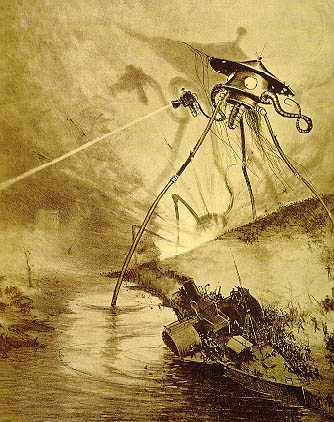
War of the Worlds: Radio Scare
Lots of cool resources on the 1938 radio broadcast of The War of the Worlds are available online! The following may be of interest:
• You can listen to the full radio show on the Mercury Theater website.
• Read a complete transcript of the broadcast.
• See more press coverage and articles gathered by Jeff Miller.
• Check out what Space.com has to say about the whole thing: why we fear the aliens, and whether we'd be vulnerable to such a hoax today.
Enjoy the goodies!
• You can listen to the full radio show on the Mercury Theater website.
• Read a complete transcript of the broadcast.
• See more press coverage and articles gathered by Jeff Miller.
• Check out what Space.com has to say about the whole thing: why we fear the aliens, and whether we'd be vulnerable to such a hoax today.
Enjoy the goodies!
Subscribe to:
Posts (Atom)